The Courage to Be Heard
There is a moment before every honest sentence, it’s that pause where you decide whether you will show up or stay safe.
Using your voice is not casual. It is exposure.

Every time you open your mouth to say what you actually think, what you feel, or what you need, you take a social and emotional risk. You might be misunderstood. You might be disagreed with. You might be seen.
And being seen changes everything.
Many of us learned early to soften, to filter smooth edges, or translate our truth into something more comfortable for the room. Not because we were weak, but because we were perceptive. We sensed the consequences, the outcomes, and the risks.
But the cost of silence accumulates. And when your voice stays small, your life does too.
The Body Knows Before the Words
Have you ever noticed how your throat tightens when you hold something in? Or your stomach churns with a knowing, or a bubble of intensity when you have something important to release? Or how relief washes through your chest after you finally say it?
Your voice is not just communication. It is physiology.

The muscles of breathing, the vagus nerve, facial expression, tone, and rhythm all work together to signal safety, to yourself and to others. A steady voice calms the nervous system and a suppressed one keeps the body vigilant.
Speaking truthfully is regulating.
When you practice being present and grounded while you speak, your words land differently. You don’t need to be louder, you only need to be clearer. Controlled does not mean restricted. It means you are inhabiting your body while your voice travels through it.
Primordial Sound: Before Language
Long before we used complex vocabulary, we used tone.
Humming. Calling. Singing across distance. Sound was connection.
These primordial tones still live inside you. A sigh, a hum, a sustained note, a growl, even a wail. These tones bypass overthinking and organize breath, posture, and emotion simultaneously. You don’t need musical training to access them. You need willingness.

There’s a reason singing feels vulnerable, because it reveals the unedited self. Your speaking voice carries thoughts, but your singing voice carries being.
When you stop singing, you don’t just lose melody, you reduce emotional range. Many people can explain their lives perfectly yet feel unknown. Often, they haven’t let sound move through them.
The Throat: Expression, Not Performance
You don’t have to think of it mystically to recognize the simple truth that the throat is where inner experience becomes outer reality.
You decide what crosses that threshold.
When you habitually silence yourself, your body learns hesitation. Your thoughts become crowded because they never get released into air. The result is overthinking, not clarity.
Expression organizes identity.

You don’t need a stage.
You need repetition.
Sing while gardening.
Sing walking down the street.
Sing in your car.
Sing quietly in your kitchen at night.
Sing where you’re heard and where you aren’t.
Sing with us at our Heart Song Circle!
Public singing builds courage. Private singing builds honesty, and both matter.
Risk Is the Doorway
Opening your mouth is always a gamble; socially, emotionally, relationally. And silence is also a risk. Maybe it’s the risk of disappearing from your own life. So risk is the doorway.
Your voice does not need to impress. It needs to exist.

You will not always say things perfectly. You will not always hit the note cleanly. But each time you allow sound to come out unedited, you strengthen the pathway between who you are and how you live.
Your voice carries boundaries.
It carries tenderness.
It carries disagreement.
It carries joy.
And when you withhold it, the world adapts to a version of you that isn’t truly or fully you. We want and need, ALL of you.
Xo Nicole
Just Sing
Not to perform.
Not to prove talent.
Not to be liked.
Sing to practice existing without apology.
Your nervous system steadies.
Your breathing deepens.
Your thoughts clarify.
Your presence strengthens.
Your voice is powerful not because it is loud, but because it is aligned.
The world does not need a polished version of you.
It needs the accurate one.
So, open your mouth…in conversation, in truth, in melody.
Private or public.
Garden or sidewalk.
Whisper or full tone.
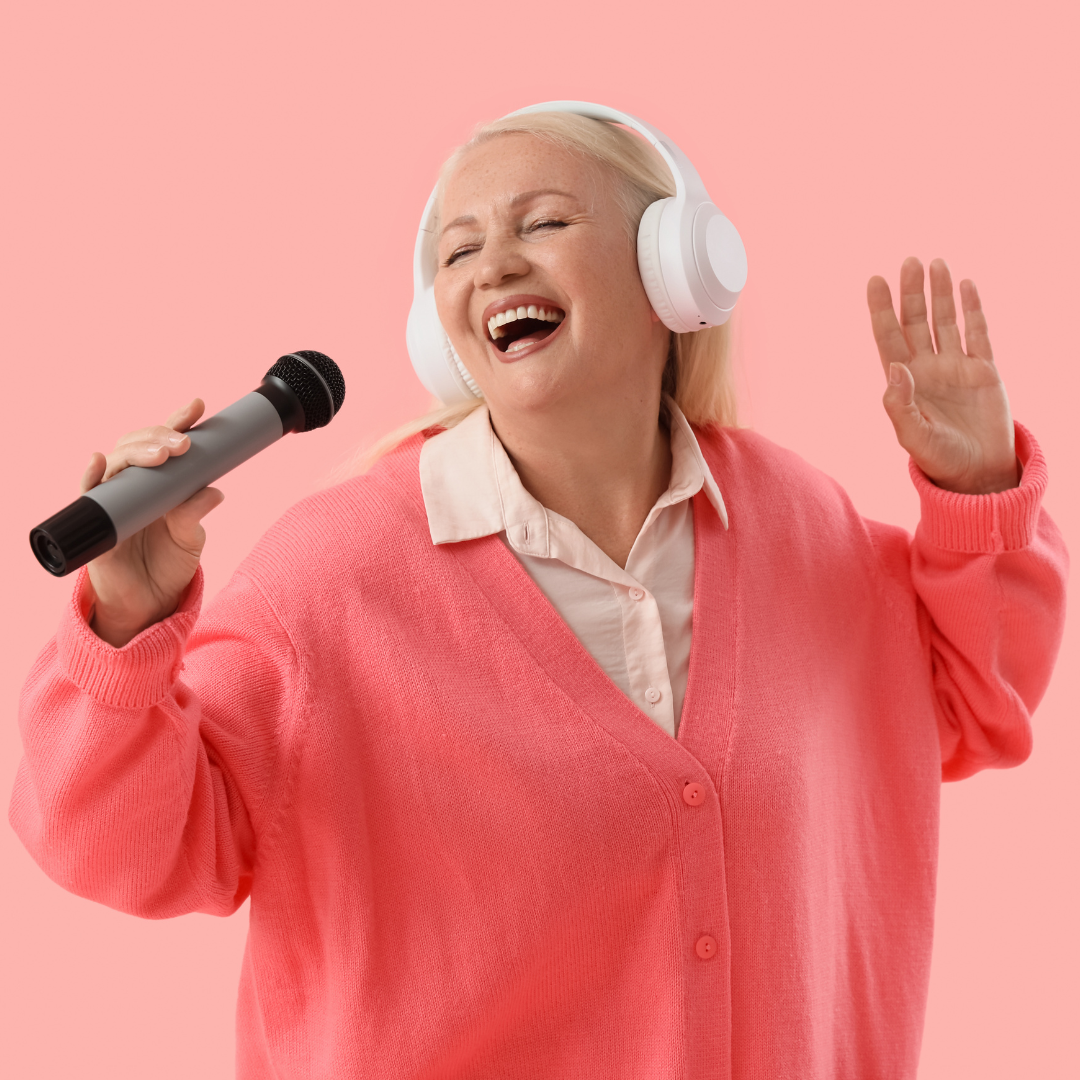
Just sing.
References
Porges, S. W. (2011). The Polyvagal Theory: Neurophysiological Foundations of Emotions, Attachment, Communication, and Self-Regulation. Norton.
Grape, C., Sandgren, M., Hansson, L., Ericson, M., & Theorell, T. (2003). Does singing promote well-being? Integrative Physiological and Behavioral Science, 38(1), 65–74.
Vickhoff, B. et al. (2013). Music structure determines heart rate variability of singers. Frontiers in Psychology, 4, 334.
Pennebaker, J. W., & Chung, C. K. (2011). Expressive writing: Connections to physical and mental health. Oxford Handbook of Health Psychology.
Thoma, M. V. et al. (2013). The effect of music on the human stress response. PLOS ONE, 8(8), e70156.